

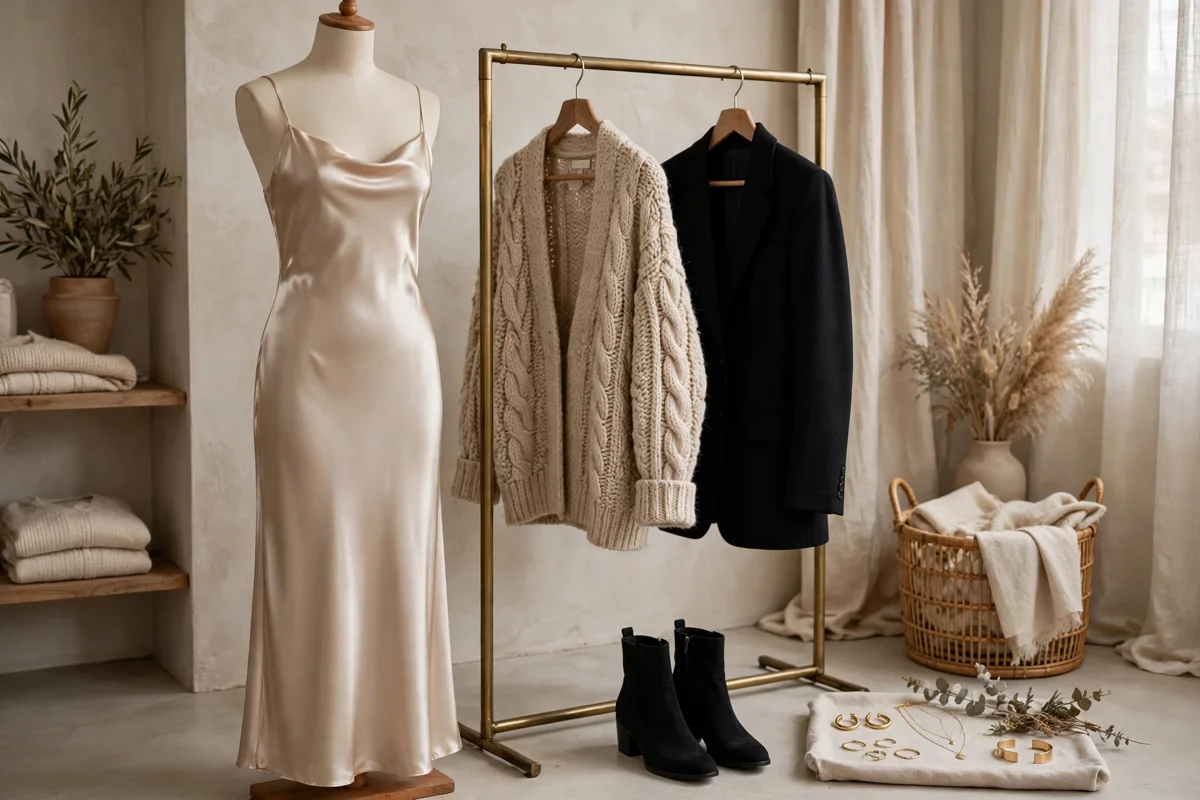
Few pieces work as hard as a slip dress. The same bias-cut dress that floats through a summer wedding can, with the right layers, carry you through autumn weekends and winter parties too. If you have ever wondered how to style a slip dress beyond its warm-weather default, this guide walks through the fabric, fit and layering choices that make one dress earn its place in your wardrobe all year round.
Start with the Right Dress
Versatility begins at the rail. A midi length in a mid-weight satin or matte crepe will layer more gracefully than a very fine silk, which can cling to knitwear and show every seam beneath it. Adjustable straps matter more than you might expect: they let you raise or lower the neckline depending on what you wear underneath. As for colour, black, navy, chocolate and deep burgundy will rotate through the seasons most easily, while pale pastels tend to stay in spring and summer.
Fit should skim rather than squeeze. A bias cut that falls smoothly over the hips leaves room for a fine knit underneath in winter and avoids the bunching that ruins the line of the dress. If you are between sizes, the larger size almost always looks more expensive worn loose than the smaller one looks worn tight.
Spring: Light Layers and Soft Structure
Spring is the slip dress’s natural season. Wear it with a cropped cardigan buttoned only at the top, or throw an unstructured blazer over your shoulders for cooler evenings. Ballet flats or loafers keep the look grounded for daytime, while a light trench handles unpredictable weather without hiding the dress.
This is also the season to experiment with accessories. Our guide to how to wear a scarf shows simple ways to add a silk square at the neck or in the hair, which softens the dress’s clean lines beautifully. Keep jewellery delicate — a fine chain and small hoops are enough while the weather is mild and the outfit is light.
Summer: Let the Dress Do the Work
In high summer, the slip dress needs almost nothing: strappy sandals, a woven bag and sunglasses. If you want one addition, make it jewellery. Our step-by-step guide to how to layer necklaces explains how to stack two or three fine chains over a slip neckline without tangles or clutter — the single easiest way to make a simple dress look considered.
For weddings and evening events, swap the day bag for something smaller. Our advice on how to choose a clutch bag will help you pick a size and finish that works with satin rather than fighting it. Hair can carry the rest of the styling: the hair accessories trends we rounded up — claw clips, bows and headbands — all pair naturally with a slip dress’s simplicity.
Autumn: The Layering Season
Autumn is where the slip dress proves its worth. Slide a fine roll-neck or a fitted long-sleeve top underneath and add ankle boots, and the dress becomes a completely different outfit. A chunky knit worn over the top, with the skirt falling below it, gives the impression of a two-piece — belt the knit at the waist if you want more shape.
Texture is your friend at this time of year. Our guide to how to wear velvet this winter includes ideas that work just as well in autumn: a velvet jacket or even velvet shoes against smooth satin creates the contrast that makes both fabrics look richer. Swap summer’s woven bag for one of the structured crossbody bags for women we reviewed, and the outfit is ready for shorter days and longer evenings.
Winter: Warmth Without Bulk
Winter styling is about what goes over and under rather than the dress itself. A thermal or fine merino layer underneath, a long wool coat over the top, and knee-high boots beneath the hem will keep a slip dress in rotation through the coldest months. For parties, skip the under-layer and rely on the coat for the journey, then let the dress stand alone indoors with statement earrings.
Dark satin shades come into their own now — burgundy, forest and midnight blue all hold their own against heavy outerwear. If the dress feels plain against winter’s richer palette, a velvet or beaded bag and a bolder lip will lift it without adding a single layer.
Common Slip Dress Mistakes to Avoid
The first is underwear that fights the fabric: visible straps, seams and lines undo the dress’s smooth finish, so choose seamless pieces and check the outfit in daylight before you leave. The second is over-accessorising. A slip dress is deliberately minimal, and one focal point — necklaces, earrings or a bag, not all three at full volume — always looks more elegant.
The third is ignoring the hem. A midi that ends at the widest part of the calf shortens the leg; a few centimetres either way makes a visible difference, and a tailor can adjust a hem cheaply. Finally, take care with storage: hang satin by its loops rather than the straps, and keep it away from rougher garments whose zips and embellishments can snag the surface.
Fabrics and Colours That Travel Across Seasons
Not every slip dress can make the full journey. Satin with a slight sheen is the most forgiving choice: it reads as evening fabric in winter and catches the light beautifully in summer. Matte crepe is the quieter option, better under knitwear because it does not slide around as you move. Pure silk is luxurious but fragile — save it for high summer and special occasions, when it will not be crushed under coats and cardigans.
Prints date faster than plains, with one exception: a small, dark floral on a black or navy ground works in every month of the year. Animal print behaves like a neutral and pairs with both summer sandals and winter boots. If you are buying your first slip dress with all four seasons in mind, choose a plain, deep colour in satin, and let your layers and accessories supply the variety — that single decision is what turns one dress into a dozen outfits.
One Dress, Four Seasons
Learning how to style a slip dress is really about learning to layer with intention. Choose a well-cut dress in a versatile colour, build a small rotation of layers and accessories around it, and the piece you bought for one summer wedding becomes one of the most reliable items you own — in January as much as in July.
