

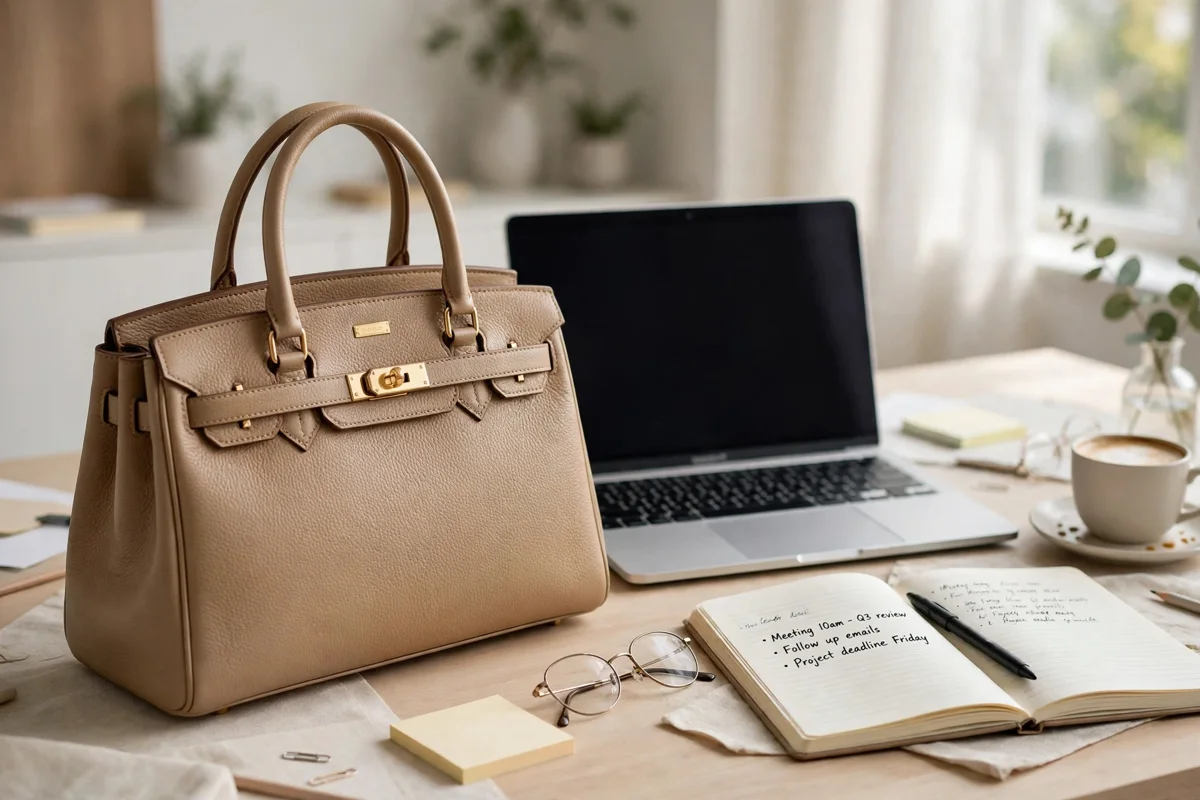
Your work bag does a lot of heavy lifting. It carries your laptop, your lunch, your makeup bag and probably a spare pair of flats — and it still has to look polished in the lift, the meeting room and everywhere in between. Knowing how to choose a handbag for work means balancing all of that without spending a fortune or wrecking your shoulder. This guide covers the sizes, shapes, materials and details that actually matter, so your next work bag works as hard as you do.
Start With What You Actually Carry
Before you fall for a beautiful bag, empty your current one onto the table and look honestly at what travels with you every day. For most of us that list includes a laptop or tablet, a phone, a purse, keys, a water bottle, a notebook and a small pouch of essentials. Measure your laptop — including its case — because “fits a 13-inch laptop” claims are not always generous.
Once you know your real load, you can judge capacity sensibly instead of guessing in a shop. If your essentials are minimal, a slim tote or a structured crossbody bag might genuinely be enough for lighter days. If you carry files, a gym kit or a change of shoes, you need a proper tote or a large satchel, and no amount of wishful thinking will shrink your belongings to fit a mini bag.
Size and Structure: The Two Non-Negotiables
How to choose a handbag for work comes down to structure more than almost anything else. A structured bag — one with a firm base and sides that hold their shape — looks instantly more professional, stands up on the floor beside your desk instead of slumping, and makes it far easier to find things. Soft, slouchy styles are lovely at weekends, but they swallow small items and can look untidy in formal settings.
As a rule of thumb, a work bag should be roughly 35–40cm wide if it needs to swallow a laptop and A4 documents without bending them. Check that the base is reinforced and, ideally, has small metal feet — they keep the bottom clean on train floors and café tiles. If you love a more formal finishing touch for evening events, a smaller structured style works on the same principles as choosing a clutch bag for evening events: shape first, decoration second.
Materials That Survive the Commute
A work bag gets rained on, knocked against ticket barriers and set down on every surface imaginable, so material choice is practical, not just aesthetic. Full-grain and saffiano leathers are the classic workhorses: saffiano’s cross-hatch finish shrugs off scratches and wipes clean, which is why so many office bags use it. Smooth leather looks beautiful but shows every scuff, so save it for bags that live a gentler life.
Good-quality coated canvas and modern recycled nylons are lighter — a real consideration if you walk part of your commute — and cope well with British weather. Whatever you choose, inspect the stitching and hardware before you buy: zips should run smoothly, seams should be even, and clasps should feel solid rather than tinny. A five-minute check in the shop prevents the classic disappointment of a strap giving way on the platform. Looking after leather properly afterwards matters too, and the same care principles in our jewellery care guide — clean, dry, stored properly — apply to bags just as well.
Straps, Handles and Comfort
The prettiest bag in the world is a bad purchase if it hurts to carry. Look for two carrying options: sturdy top handles for a polished hand or elbow carry, plus a longer detachable strap so you can switch to your shoulder or crossbody when the bag is fully loaded. Straps should be wide enough not to dig in, and handle attachments should be stitched or riveted through reinforced panels, not glued.
Try the bag on with your coat — straps that fit over a summer blouse may not slide over a winter sleeve. And be honest about weight: pick the empty bag up in the shop. If it already feels heavy before the laptop goes in, it will be miserable by Friday. Comfort is also why so many commuters keep a smaller bag for evenings and social plans, then add a finishing touch such as a scarf styled with a simple outfit rather than carrying the big tote everywhere.
Colour and Versatility
Your first work bag should earn its keep across your whole wardrobe. Black is the default for a reason, but tan, burgundy, navy and deep olive often work harder — they soften black tailoring, sit happily with navy and grey, and hide minor scuffs better than pale shades. If you wear a lot of one colour family, choose the bag that disappears into those outfits rather than fighting them.
Hardware colour matters more than people expect. If you mostly wear gold jewellery, gold-tone zips and clasps will feel more cohesive; silver-tone suits silver jewellery and cooler wardrobes. It is a small detail, but it is the kind of thing that makes an outfit look deliberately put together. If you are building a coordinated look from scratch, our guide to choosing jewellery as a gift has useful notes on matching metals and tones that apply just as well to your own collection.
Pockets and Organisation
A single cavernous compartment is where keys, lip balms and travel cards go to disappear. Look for, at minimum, a padded laptop sleeve, a zipped pocket for valuables and two slip pockets for your phone and card holder. A key leash — a strap with a clip inside the bag — sounds trivial until the first rainy evening spent tipping your bag out on the doorstep.
Think about security too. A full zip closure is far safer on crowded trains than an open tote top, and an interior zipped pocket keeps your purse out of sight. If your bag lacks built-in organisation, a felt bag organiser insert is an inexpensive fix that also makes swapping bags much faster. The same “everything in its place” thinking keeps your dressing table calmer as well — see our jewellery storage ideas for small-space inspiration.
Finding Your Perfect Work Bag
Learning how to choose a handbag for work is really about honesty: be honest about what you carry, how far you walk and what your working wardrobe actually looks like. Choose structure over slouch, a material that can handle the commute, straps that respect your shoulder and a colour that goes with everything you own. Get those five things right and your bag will look polished in every meeting — and still be going strong long after a flimsier fashion buy would have given up.
